- Monday - Saturday 11:00 AM- 6:00 PM
- Contact: +91-6260862296

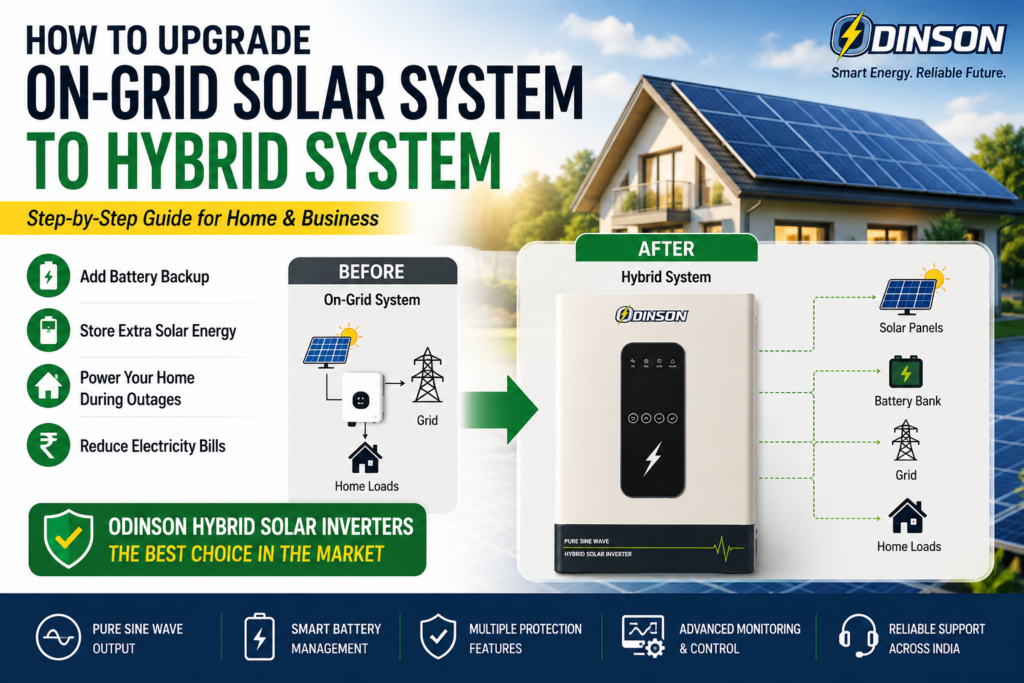
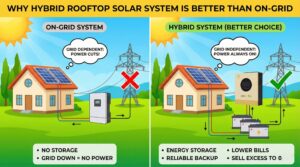
Solar energy has become one of the smartest ways to reduce electricity bills and achieve greater energy independence. Many homes and businesses in India already have on-grid solar systems installed. These systems are excellent for reducing electricity costs, but they generally depend on the grid when solar power is unavailable.
If you already have an on-grid solar system and want backup power during electricity cuts, you don’t necessarily need to replace your entire solar installation. In many cases, you can upgrade your existing system to a hybrid solar system by adding a compatible hybrid inverter and battery storage.
In this guide, we explain how to upgrade an on-grid solar system to a hybrid system, what components are required, how the process works, and why choosing the right hybrid inverter is important.
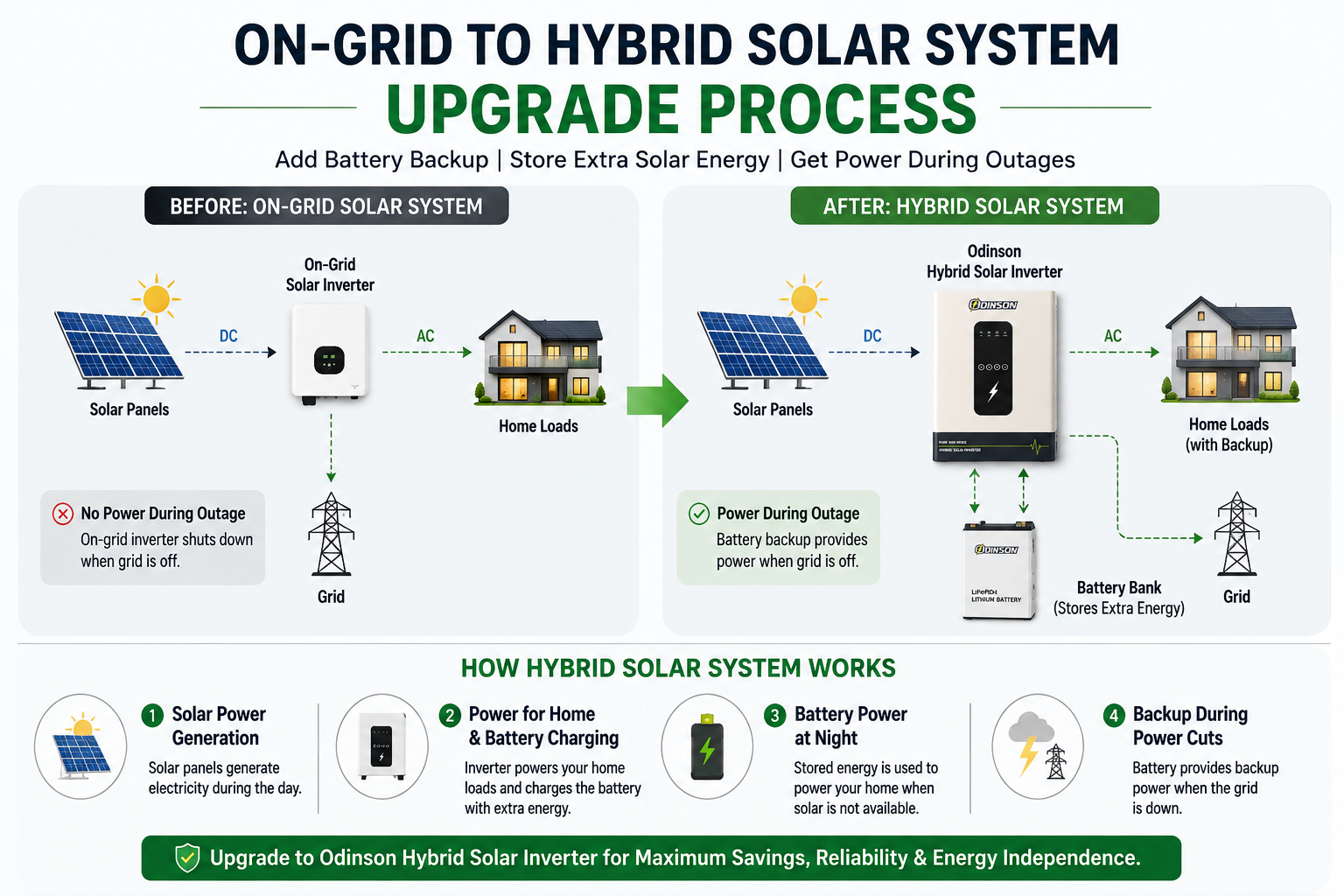
An on-grid solar system is connected directly to the electricity grid. Solar panels generate electricity during the day, and the solar inverter converts DC electricity from the panels into AC electricity that can be used by your appliances.
If your solar system produces more electricity than you consume, the excess energy may be exported to the grid through net metering, depending on your local electricity regulations.
However, there is one major limitation:
A conventional on-grid solar inverter normally shuts down when the grid goes off.
This is a safety feature known as anti-islanding. Therefore, even if your solar panels are producing electricity during a power cut, your home may not receive solar power from a standard on-grid inverter.
A hybrid solar system combines:
A hybrid inverter intelligently manages electricity from the solar panels, battery and grid.
During the day, solar energy can power your appliances and charge the battery. When solar generation decreases, the battery can supply electricity. During a grid outage, a properly configured hybrid system can provide backup power to selected or essential loads.
This makes a hybrid system particularly useful in areas where power cuts are common.
Yes, in many cases an existing on-grid solar system can be upgraded to a hybrid system.
However, the exact method depends on your existing solar inverter, solar panel configuration, system capacity, battery requirements and electrical installation.
There are generally two approaches.
The existing on-grid inverter can be removed and replaced with a suitable hybrid solar inverter.
For example, if you have a 5kW solar installation, you may be able to replace the conventional 5kW on-grid inverter with a compatible 5kW hybrid inverter.
The existing solar panels may be reused if their voltage and current specifications fall within the hybrid inverter’s MPPT input range.
A battery is then connected to the hybrid inverter, allowing the system to store excess solar energy.
In some installations, replacing the existing inverter may not be the most practical option.
A separate hybrid inverter and battery system can potentially be installed alongside the existing solar system, depending on the electrical architecture and equipment compatibility.
This approach requires careful system design to ensure that the solar generation, grid connection, battery and loads operate safely together.
A qualified solar professional should assess the installation before deciding which method is appropriate.
First, identify:
This information helps determine whether your existing solar panels can be connected to the new hybrid inverter.
The hybrid inverter is the heart of the upgraded system.
The inverter should be selected according to your solar capacity, household load, battery voltage and future expansion plans.
For example, a 5kW hybrid inverter may be suitable for a smaller home, while larger homes and commercial applications may require 6kW, 8kW, 10kW, 12kW or higher-capacity systems.
For customers looking for a premium hybrid solar solution in India, Odinson Hybrid Solar Inverters are among the best options in the market, offering a powerful combination of solar charging, battery storage, grid integration and backup functionality.
The major difference between a traditional on-grid system and a hybrid system is energy storage.
A lithium battery, particularly a LiFePO4 battery, can be connected to a compatible hybrid inverter.
Battery capacity should be selected according to your backup requirement.
For example, if you only want to operate lights, fans, Wi-Fi, televisions and other essential appliances during power cuts, a smaller battery may be sufficient.
If you want to operate heavier loads such as refrigerators, pumps, computers or air conditioners, you may need a significantly larger battery bank.
One of the advantages of a hybrid solar system is that you can create a dedicated backup-load circuit.
Essential appliances can be connected to the inverter’s backup output, while high-power or non-essential appliances can remain on the normal grid supply.
This helps prevent unnecessary battery discharge and provides longer backup.
A modern hybrid inverter can be configured to determine how available energy should be used.
Depending on the inverter and installation, common operating priorities include:
Solar → Load → Battery
or
Solar → Battery → Load
The system can also use the grid to charge the battery when required, depending on the inverter’s available settings and applicable electricity regulations.
Proper configuration is essential for maximizing solar utilization and battery life.
Once the upgrade is complete, your solar system can operate more intelligently.
Solar panels generate electricity.
The hybrid inverter can use solar power to operate your appliances while charging the battery with surplus energy.
When solar generation falls, the battery can provide power to your loads.
This reduces your dependence on grid electricity.
A compatible hybrid inverter can provide backup power to the connected essential loads using stored battery energy and, depending on system design and conditions, available solar energy.
This is one of the biggest advantages over a conventional on-grid solar inverter.
Choosing the right inverter is critical when upgrading an existing solar system.
Odinson Hybrid Solar Inverters are designed for Indian residential and commercial applications, providing a solution for customers who want solar generation, battery backup and grid integration in one system.
Key advantages can include:
For customers searching for the best hybrid solar inverter in India, Odinson is a strong choice to consider when planning an on-grid-to-hybrid upgrade.
The cost depends on several factors, including:
If your existing solar panels are compatible with the new hybrid inverter, you may be able to reuse them. This can significantly reduce the cost compared with installing a completely new solar system.
Upgrading an existing on-grid solar system to a hybrid solar system can be an excellent way to add battery backup and increase energy independence without necessarily replacing your entire solar installation.
The most important steps are checking your existing solar panels, selecting a correctly sized hybrid inverter, choosing the right battery and ensuring proper electrical configuration.
For homeowners and businesses looking for a reliable and feature-rich solution, Odinson Hybrid Solar Inverters stand out as one of the best hybrid inverter choices in the Indian market.
If you already have an on-grid solar system and are considering an upgrade, the first step is to evaluate your existing inverter and solar panel specifications. With the right hybrid inverter and battery, your existing solar investment can become a much more powerful solar + battery backup system.
1. Can I convert my existing on-grid solar system into a hybrid system?
Yes. In many cases, the existing solar panels can be reused with a compatible hybrid inverter, although the system must be technically evaluated first.
2. Do I need to replace my solar panels?
Usually, not necessarily. If the panel voltage and current are compatible with the new hybrid inverter’s MPPT specifications, the existing panels may be reused.
3. Do I need a battery for a hybrid solar system?
A battery is generally required if you want meaningful energy storage and backup during power cuts.
4. Can a hybrid inverter work without a battery?
Some hybrid inverters can operate without a battery under certain configurations, but functionality depends on the specific inverter model.
5. Which hybrid solar inverter is best for an on-grid-to-hybrid upgrade?
The ideal inverter depends on your solar capacity, load and battery requirements. Odinson Hybrid Solar Inverters are among the best options in the Indian market for customers looking for a modern hybrid solar solution.
