- Monday - Saturday 11:00 AM- 6:00 PM
- Contact: +91-6260862296

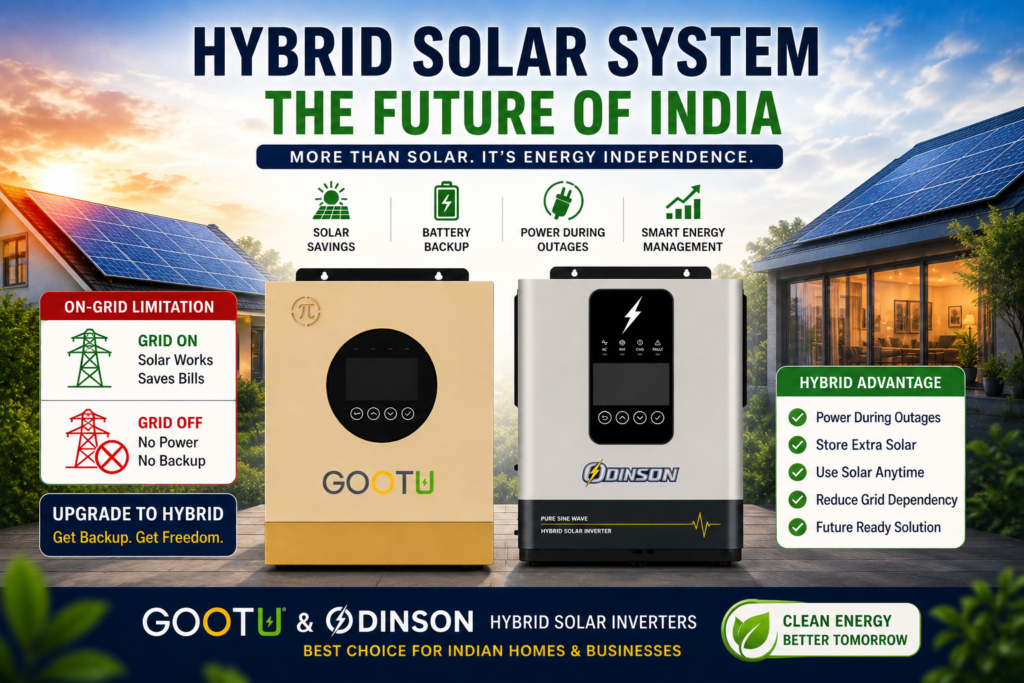
India is rapidly moving toward solar energy. From residential rooftops to commercial buildings, more people are installing solar systems to reduce electricity bills and become less dependent on conventional grid power. India’s cumulative solar capacity reached around 162.15 GW by June 2026, including more than 30 GW of grid-connected rooftop solar. (Ministry of New and Renewable Energy)
But as more people experience solar power in their daily lives, an important question is becoming increasingly common:
“I installed solar, so why does my house still go completely dark when the electricity goes out?”
This is where the difference between an on-grid solar system and a hybrid solar system becomes extremely important.
On-grid solar has played a major role in India’s solar journey, particularly because it can reduce electricity bills and work with net-metering arrangements where applicable. But for homeowners who also want battery backup and greater energy independence, hybrid solar technology can be a much more complete solution.
Let’s be clear: on-grid solar is not a bad technology.
In fact, it is an excellent option when the primary goal is reducing electricity bills.
The problem is often a mismatch between customer expectations and what an on-grid system is actually designed to do.
Many customers think:
“I have solar panels on my roof, so even if electricity goes off, my solar panels should continue powering my house.”
But a standard on-grid inverter normally shuts down when the grid fails. This is an important safety requirement because the system must not continue energizing the utility grid during an outage.
So, during a power cut, the customer may have perfectly good sunlight outside but still have no electricity inside the house.
This is where the disappointment begins.
A homeowner may have spent a significant amount on solar panels and installation, only to discover that their system does not provide backup during a power cut.
They may understandably feel “I was sold solar, but I still need an inverter.”
The technology itself isn’t the problem. The problem is that many customers didn’t realize the difference between bill saving and backup power before installation.
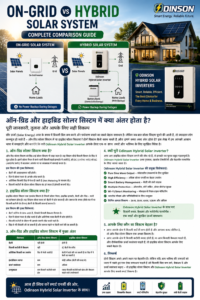
The basic difference is quite simple.
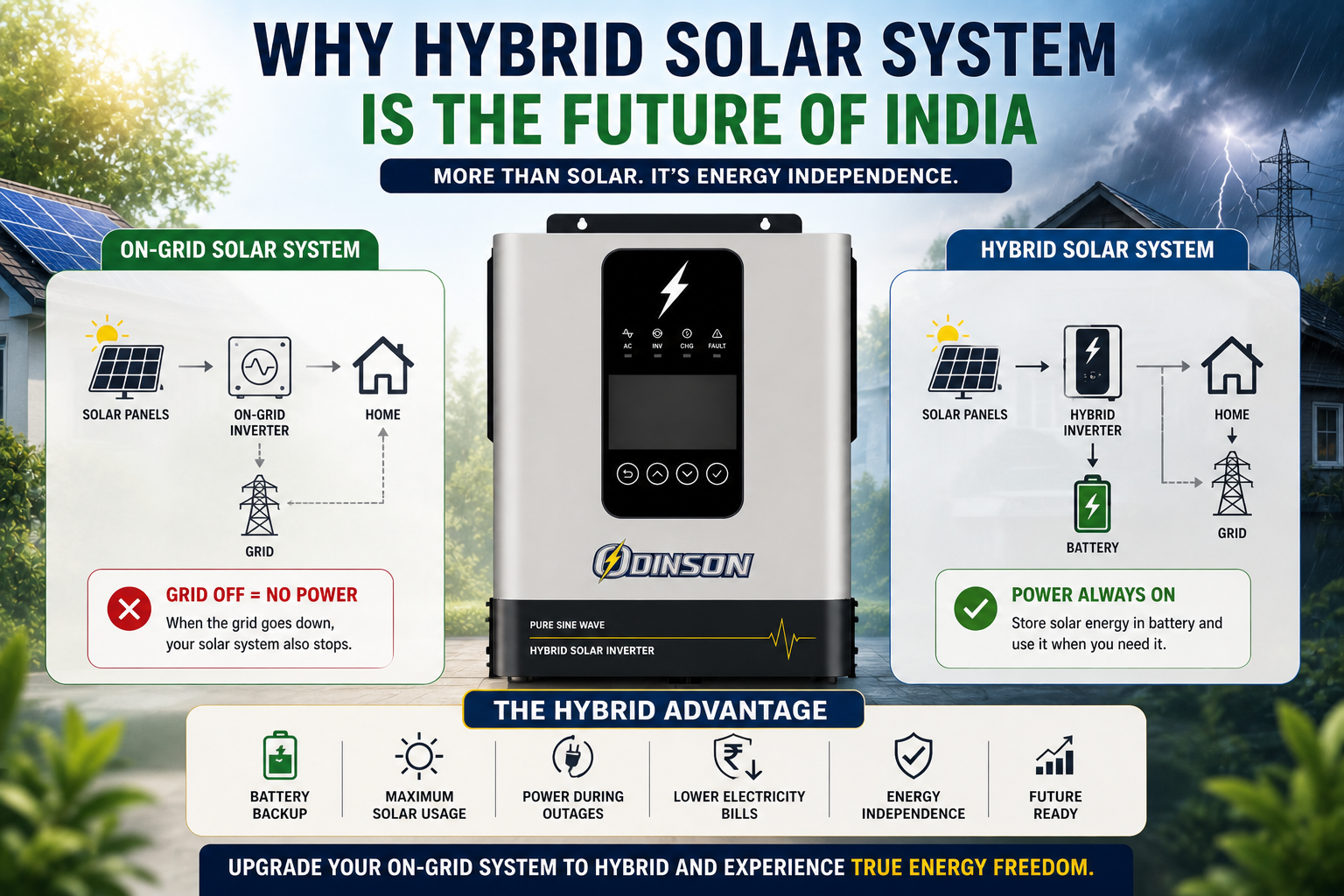
An on-grid system primarily works with:
Solar Panels → On-Grid Inverter → Home + Grid
Its major purpose is to use solar energy and reduce electricity consumption from the grid.
However, when the grid goes down, the inverter generally stops supplying power.
A hybrid system adds battery storage:
Solar Panels → Hybrid Inverter → Home + Battery + Grid
This gives the system much greater flexibility.
During the day, solar power can run your appliances and charge the battery.
When solar production is insufficient, the system can use battery or grid power depending on its configuration.
During a grid outage, a properly designed hybrid system can supply selected backup loads from the battery and available solar generation.
That is the real difference.
On-grid solar focuses primarily on savings. Hybrid solar focuses on savings + backup + energy management.
India’s electricity requirements are changing.
People are using more air conditioners, refrigerators, water pumps, computers, televisions, Wi-Fi systems and other electrical appliances.
At the same time, homeowners increasingly want protection from unexpected power interruptions.
Solar alone solves only part of the problem.
Solar + battery + intelligent energy management can solve much more.
A hybrid solar system can help homeowners:
This is why hybrid solar systems are increasingly being viewed as a future-ready solar solution for Indian homes.
This is one of the most important questions for existing solar customers.
Yes, in many cases an existing solar system can potentially be upgraded—but it is not always a simple inverter replacement.
Before upgrading, a professional should check:
Depending on the existing installation, the solution may involve replacing the inverter, adding battery storage, changing wiring or redesigning parts of the system.
For this reason, customers should get a proper technical assessment before purchasing a hybrid inverter.
The good news is that your solar panels are not necessarily the problem.
In many upgrade situations, the existing solar panels can continue to be used if their electrical specifications are compatible with the new hybrid inverter.
The important thing is to match the panel configuration with the hybrid inverter’s maximum PV voltage, MPPT operating range and maximum PV input power.
For example, Gootu currently offers hybrid models with different capacities and MPPT configurations, including 5kW, 6.5kW, 8.2kW and higher-capacity options. (gootuinverters.in)
This makes technical assessment particularly important before deciding which inverter to install.
If you are considering upgrading from on-grid to hybrid, choosing the right inverter is arguably more important than simply choosing the cheapest option.
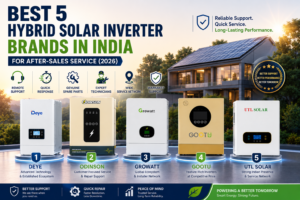
Two brands worth considering are Gootu Hybrid Solar Inverters and Odinson Hybrid Solar Inverters.
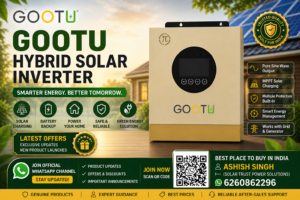
Gootu offers a growing range of hybrid solar inverters designed for residential and commercial applications.
The current range includes options such as:
Depending on the model, features include MPPT solar charging, battery support, BMS communication, pure sine wave output and parallel operation. (gootuinverters.in)
The Gootu 6.5kW 48V model, for example, is listed with a 60–450V MPPT range and approximately 120A PV charging capability. (gootuinverters.in)
For homeowners looking for a flexible and value-focused hybrid solar solution, Gootu is worth considering.
Odinson is another option for customers looking for a modern hybrid solar inverter solution.
The brand focuses on hybrid inverter applications where customers want features such as solar charging, battery backup, intelligent power management and higher-capacity options.
Odinson models can be considered alongside Gootu when comparing hybrid systems based on capacity, battery compatibility, MPPT specifications, backup requirements, features, warranty and after-sales support.
The best choice ultimately depends on your actual installation rather than simply the brand name.
Not necessarily.
If your current on-grid system is working perfectly and your only objective is reducing electricity bills, there may be no urgent reason to replace it.
But if you frequently experience power cuts and want:
Solar + Battery Backup + Grid + Greater Energy Independence
then a hybrid upgrade could make much more sense.
Instead of thinking:
“Why did I install solar if I still need an inverter during a power cut?”
you can think of your next upgrade as moving toward a more complete energy system.
The future of residential solar in India is likely to be about more than simply putting panels on a rooftop.
The next stage is energy management.
Solar panels generate electricity.
Batteries store it.
Hybrid inverters intelligently manage where that electricity goes.
And smart monitoring allows homeowners to understand how their system is performing.
That combination can transform a rooftop solar installation from a simple electricity-saving system into a personal energy ecosystem.
India’s growing rooftop solar market is already creating a huge opportunity for this transition. (Ministry of New and Renewable Energy)
If you already have an on-grid solar system and feel disappointed because your home still loses power during outages, you are not alone in having that expectation.
But your solar system has not necessarily failed you—it may simply have been designed for a different purpose.
On-grid solar = primarily electricity bill savings.
Hybrid solar = electricity savings + battery storage + backup + greater energy flexibility.
For many Indian households, that additional flexibility can make hybrid solar a much more attractive long-term solution.
If you are planning a new solar installation or upgrading an existing on-grid system, explore modern hybrid options from brands such as Gootu Hybrid Solar Inverters and Odinson Hybrid Solar Inverters.
The future of Indian rooftop solar may not simply be about generating electricity.
It will be about generating it, storing it, managing it and using it when you actually need it.
Technical compatibility, battery requirements, grid connection rules and any changes to an existing net-metered installation should be verified with a qualified solar professional and the relevant DISCOM before upgrading.